|
Anarchive n°8 - Muntadas Media Architecture Projects
This eighth title in the anarchive collection, Muntadas, Media Architecture Projects, comprises a book and a web-based project: map.anarchive.net.
It explores five series of works encompassing significant projects reflecting Muntadas's approach, produced since 1999. These projects are significant both for their methodology and the questions they raise: On Translation, The Construction of Fear, About Academia, Asian Protocols, Strategies of Displacement
The artist took the iceberg metaphor as his starting point. The visible portion offers a journey through the projects as they are presented to the public. The much larger, invisible portion consists of three levels:
The concept: notes, preparatory drawings, and excerpts from interviews with the artist.
The process: the stages and methods of research, production, and installation of the projects. (including around twenty original interviews with collaborators).
The local and general context: the city, the architecture and the activities of the exhibition space, and through a few essays and links to other sites, an evocation of the social, political, geographical, historical, cultural or technical conditions that accompany the development of the projects.
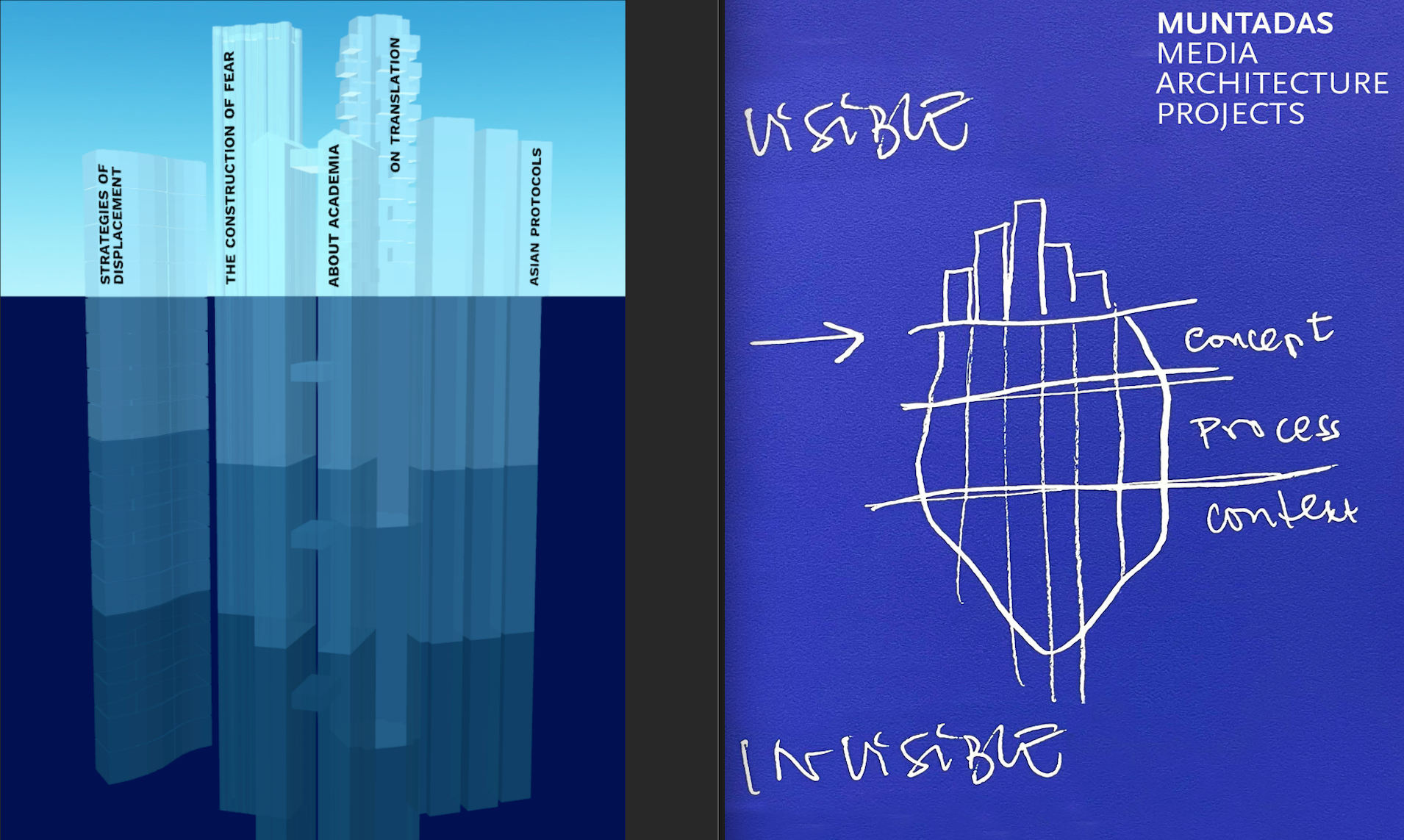
| map.anarchive.net |
[This project is suitable for viewing on a smartphone]
Antoni Muntadas: originator
Anne-Marie Duguet: editorial direction, research and conducting of interviews
For the website:
Benoit Zenker: interactive 3D design and development
For the book:
Teresa Mulet: graphic design
Proofreading and corrections: Joséphine Watson
Translations: Joan Olivar, Tania Ruiz Gutierrez
Production: Anarchive
in collaboration with ARXIU/AM (Barcelona)
Staff and advisors: Andrea Nacach, Gilles Rouffineau, Roland Le Breton, Victoria Sacco Piffer, Valentín Roma, Eugeni Bonet, Juan Herreros, Enrique Walker, Clara Joly, Anitra Louries, Clara Popelka, Maria Del Carmen Caballé Tutosaus, Teresa Mulet, Anna Doyle, Hélène Sirven
Translations of some interviews: Joséphine Watson, Emma Saúl, Idiomas BCN
Thanks:
Bachir Soussi Chiadmi, Yves and Aël Trémorin, Christian Boustani, Joan Olivar, Maria Puig Roca Sastre, Christophe Leclercq, Daniela Stubbs-Levi, Beth Tubert Costa
With the support of:
 Fondation Antoine de Galbert Fondation Antoine de Galbert
 Ministère de la Culture, Délégation aux Arts Plastiques (DICREAM) Ministère de la Culture, Délégation aux Arts Plastiques (DICREAM)
 Institut Ramon Lull Institut Ramon Lull
 Le projet de recherche ATLAS AV Le projet de recherche ATLAS AV
 Université Paris 1 (ACTE Lab) Université Paris 1 (ACTE Lab)
Antoni Muntadas
From his earliest experiments, Muntadas has focused his artistic activity on the critique of the media: systems of representation and information such as television, the press or advertising, but also architecture, that of public buildings or the invisible architecture of telecommunications networks.
From his earliest experiments, Muntadas has focused his artistic activity on the critique of the media: systems of representation and information such as television, the press or advertising, but also architecture, that of public buildings or the invisible architecture of telecommunications networks.
Reading "between the lines" To grasp the objective and subjective meanings of language and images, Muntadas addresses the “invisible mechanisms” that shape the production and reception of mass media discourse. He analyzes the processes by which information is mediated and manipulated.
This critical activity relies on strategies of appropriation, fragmentation, decomposition, isolation, and reframing of images and texts. It involves creating spaces, a void between signs, lines, frames, and sounds, to grasp new relationships, to slow down in order to see/hear something else. It is also about revealing, through sometimes unusual connections, the profound relationships between the fields of culture, politics, economics, religion, and sport. Producing questions is Muntadas's primary approach.
The rhetoric of this work is based on a series of dualities (art/life, broadcast/reception, visible/invisible, private/public, subjectivity/objectivity, video/television, etc.) examined in their relationships of attraction, reciprocity, and opposition. The development of metaphors, the reinterpretation of architectural archetypes, the staging of media, the dramatization of social and political rituals, are all fundamental procedures of a work deeply engaged in current social reality.
|